
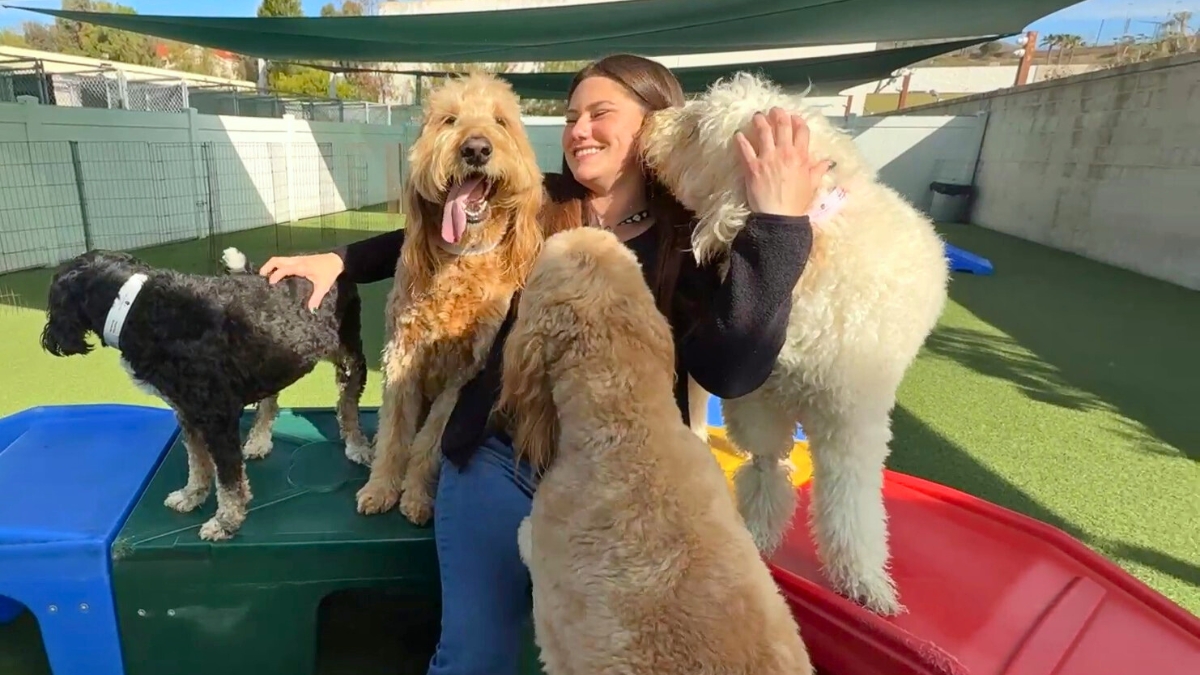
Corona dog owners often see the same issue: dogs respond at home but ignore commands in public, jump on guests, or pull on leash. This gap comes from inconsistent training and limited exposure to real-world distractions.
Professional day training closes that gap through daily expert instruction and progressive real-world practice. Smart Parke’s Corona location builds reliable obedience, confidence, and focus—creating lasting behavioral change, not temporary compliance.
Why Dogs Obey at Home but Fail in Public
Dogs don’t automatically generalize commands. A behavior learned at home doesn’t instantly transfer to parks or busy environments, because dogs associate commands with specific contexts.
Distractions Override Training
When excitement or stress rises—other dogs, noises, new smells—your dog’s brain prioritizes environmental input over learned commands. This isn’t defiance; it’s a neurological response.
How Progressive Exposure Fixes It
Training in gradually more distracting environments builds reliability. Day training systematically expands where commands are practiced, helping behaviors become automatic in any setting.
Why Day Training Outperforms Weekend Classes
Corona’s working professionals often try once-weekly group classes, hoping consistent effort on their part will create behavioral change. Yet research from the International Association of Canine Professionals shows that dogs trained through daily professional instruction develop habits 40% faster than those in weekly group settings.
The difference lies in frequency and consistency—your dog’s brain requires multiple daily reinforcements to establish automatic behavioral responses, not sporadic weekly practice competing with other dogs for trainer attention.
The Science Behind Behavioral Habit Formation
Day training eliminates three critical obstacles present in group classes: owner inconsistency, limited trainer focus, and inadequate practice frequency. A professional trainer working with your dog daily catches mistakes immediately, corrects them in real-time, and progressively increases difficulty—building reliability that actually transfers to real-world situations.
Your dog learns not just what commands mean, but that commands work everywhere, in all contexts, with all people. Environmental enrichment and structured daily practice also reduce stress-related behaviors, making your dog calmer and more receptive to learning throughout their training journey.
What Effective Day Training Includes
Quality day training combines daily, goal-focused sessions with personalized instruction based on your dog’s age and temperament, using positive reinforcement methods. Training progresses from controlled indoor spaces to outdoor environments with increasing distractions, helping your dog generalize commands across real-world settings.
Effective programs also provide daily progress reports and follow-up sessions, keeping you informed and teaching you how to reinforce behaviors at home so results last beyond formal training.
Is Day Training Right for Your Dog?
Not every dog needs day training, and honest facilities understand this distinction. Day training works best for dogs whose owners want to accelerate behavioral change, dogs with inconsistent behavior across environments (obedient at home but reactive at the park), high-energy dogs needing structured outlet, or dogs preparing for life changes like new family members or moving to apartment living.
Dogs Who Thrive in Day Training
Social dogs with moderate to high energy often excel in day training due to structured engagement and expert guidance. Dogs with inconsistent obedience benefit as trainers quickly identify and correct issues owners may miss. Working breeds and high-drive dogs thrive in this setting because it provides the consistent challenge their temperament requires.
Dogs Who May Need Professional Assessment First
Dogs with untreated aggression toward other dogs, dogs experiencing chronic pain causing irritability, or dogs with severe anxiety may benefit from veterinary behavioral evaluation or specialized training before standard day training. A quality facility honestly assesses your dog during consultation and recommends alternatives if needed—whether that’s private training, medical treatment, or behavioral specialist referral.
Day Training vs. Private In-Home Training vs. Group Classes
Corona pet owners choose between three primary training formats, each with distinct advantages and limitations.
| Training Type | Speed of Progress | Consistency | Real-World Transfer | Cost Range |
| Day Training | High (2-4 weeks) | Daily professional instruction | Excellent (multiple environments) | $150-200+/day |
| Private In-Home Training | Medium (4-8 weeks) | Owner-dependent between sessions | Limited (home environment only) | $75-150/hour |
| Group Classes | Low (8-12+ weeks) | Weekly sessions | Poor (limited transfer to real-world) | $300-500 for program |
A study in the Journal of Veterinary Behavior found that dogs receiving daily professional instruction showed 67% greater obedience consistency after 4 weeks compared to once-weekly group classes. The critical difference: daily frequency prevents habit regression, immediate correction addresses mistakes before they become patterns, and progressive difficulty ensures reliability across all environments.
The Positive Reinforcement Advantage
Research published in PLOS ONE confirms that dogs trained with positive reinforcement display significantly fewer stress-related behaviors and maintain lower cortisol levels compared to punishment-based methods.
Stressed dogs learn less effectively—they enter fight-or-flight states that impair learning and create new behavioral problems. Reward-based training keeps your dog calm, engaged, and motivated, producing more durable behavioral change and stronger handler bonds.
Corona Day Training: Facility Features and Advantages
Smart Parke’s Corona location features 20,000 square feet with three unique play yards and 7,100 square feet of combined indoor and outdoor space—providing trainers diverse environments for progressive skill building.
The resort-style facility allows trainers to start your dog in controlled indoor spaces, progressively introduce outdoor distractions, and eventually practice commands alongside other dogs and environmental challenges that mimic real-world scenarios.
Building Confidence Through Progressive Challenge
Effective day training isn’t just about obedience—it’s about building genuine confidence in your dog. A dog that responds reliably to commands in distracting environments is a confident dog, secure in their understanding of expectations and capable of making good choices regardless of circumstances. This confidence extends beyond training: confident dogs are less anxious, less reactive, and more emotionally stable overall.
What Success Looks Like After Day Training
After completing day training, your dog should respond reliably to core commands (sit, stay, come, down, heel) in varied environments with minimal distraction. Behavioral issues should show measurable improvement—jumping reduced, barking controlled, leash pulling minimized.
More importantly, your dog should demonstrate understanding of expectations and genuine enthusiasm for training, having learned that compliance brings rewards and their handler’s attention.
Customized Training Programs at Corona
Day training rates at Corona start at $150/day for professional instruction, or consider the Board and Train program ($150/day plus boarding) for intensive behavioral work. Both formats include two daily training sessions, customized instruction, daily progress reports, and one follow-up owner session teaching maintenance techniques.
Boarding options range from Classic ($69/night) to Luxury ($95/night) to Private suites ($114-140/night), allowing you to structure intensity that matches your dog’s needs.
Corona’s facility includes 24/7 on-site staff supervision, high-quality house cuisine formulated to avoid upset stomachs, optional enrichment add-ons (cuddle time, ball play, grooming), and training follow-up sessions maintaining progress after formal training concludes. Contact Smart Parke Corona today and book your dog’s stay–discuss your dog’s specific behavioral goals, and explore which training format suits your timeline and budget.
Where Confidence Becomes Your Dog’s Greatest Asset
Training transforms more than just behavior—it builds your dog’s confidence and emotional resilience. A dog that understands what’s expected and receives consistent, immediate reward for compliance becomes a secure, capable companion. Day training in Corona provides expert instruction from professionals who understand canine learning science, allowing your dog to build confidence and focus that last a lifetime.
Smart Parke’s Corona facility combines diverse training environments, expert staff, and transparent progress communication, creating an ideal setting for behavioral transformation. Start with a consultation to discuss your dog’s specific goals and discover how professional day training can unlock their best self.
FAQ
How long does transformation typically take?
Most dogs show noticeable improvement in basic commands within 2-3 weeks of daily training. Behavioral issues like jumping or reactivity may take 4-6 weeks depending on how deeply ingrained the habit is and consistency of home reinforcement after training concludes.
Will my dog retain trained behaviors after day training ends?
Yes, if you maintain training at home. Dogs retain commands best through consistent daily practice—even 10 minutes daily keeps behaviors sharp. Smart Parke includes owner follow-up sessions and maintenance instructions, ensuring trained behaviors become lifetime habits.
What’s the difference between day training and board-and-train?
Day training means your dog returns home each evening while attending training sessions during the day. Board-and-train has your dog stay overnight, allowing 24/7 behavioral supervision and more intensive work. Board-and-train suits dogs needing intensive behavioral intervention; day training works well for dogs with stable home environments needing focused instruction.
Can older dogs benefit from day training?
Dogs of all ages learn and change behaviors. Puppies typically learn faster due to greater neuroplasticity, but older dogs can master new commands and overcome behavioral issues—it may require slightly longer timeframes.
How much does day training cost in Corona?
Professional day training typically starts at $150/day for instruction, or $150/day plus boarding costs if choosing board-and-train format. Most Corona dog owners see meaningful progress within 2-4 weeks. Investment in professional training often prevents costly behavioral problems and dramatically improves your dog’s quality of life.
What if my dog has severe behavioral issues like aggression?
Serious behavioral issues may require evaluation by a certified veterinary behaviorist in addition to training. Quality trainers recognize when issues have medical or psychological components and refer owners appropriately. Smart Parke trainers are experienced with varied behavioral challenges and can advise whether your dog needs additional professional support.
How often should my dog attend day training each week for best results?
Most dogs benefit from attending day training 3–5 days per week to build consistency and reinforce behaviors quickly. Some dogs can make progress with fewer days, but daily or near-daily attendance produces faster, more reliable results—especially for dogs with high energy, reactivity, or inconsistent obedience. A trainer can recommend the ideal schedule based on your dog’s temperament and training goals.